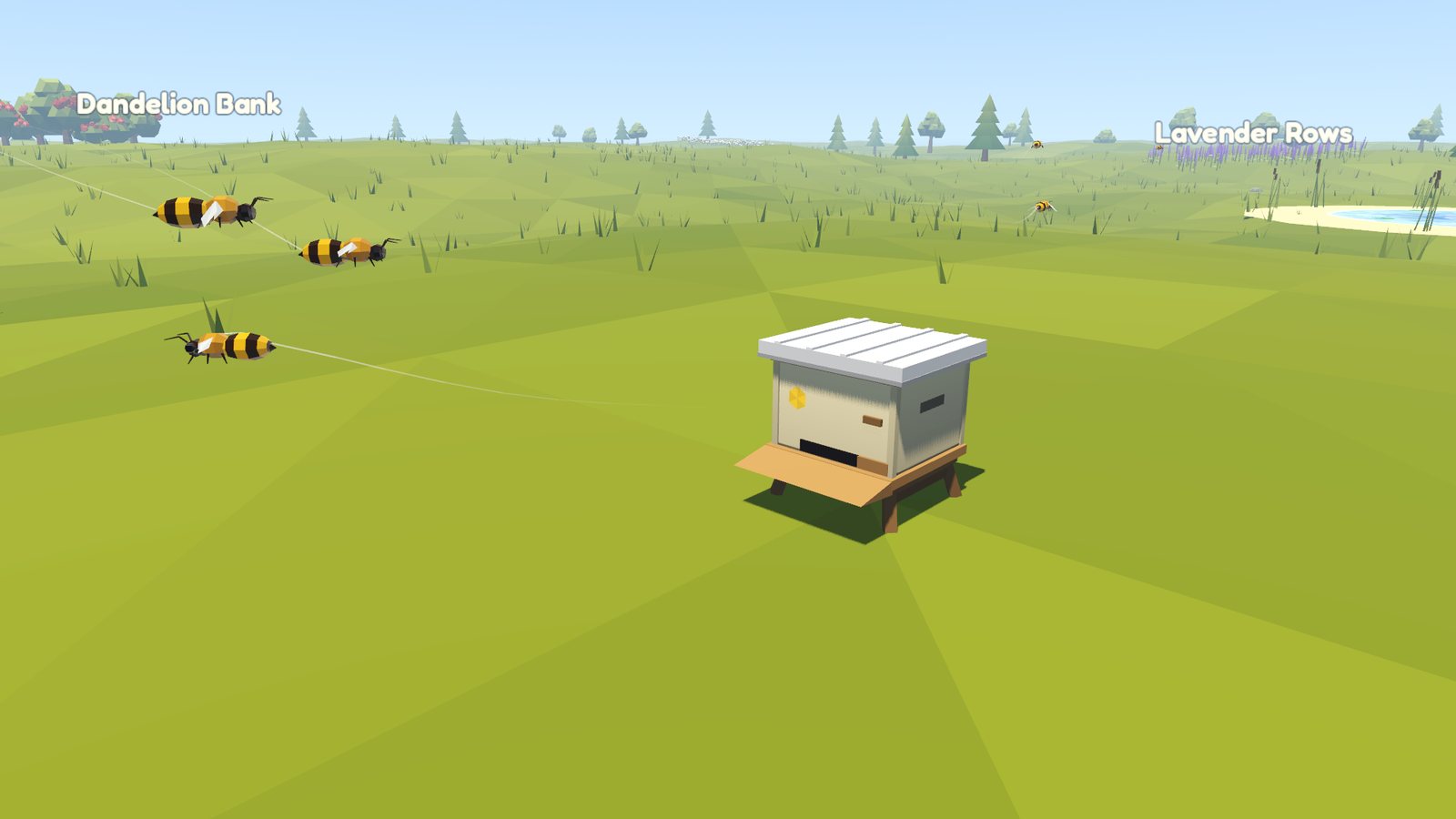
A white beehive on a green hillside, with honeybees flying out toward distant flower patches

A honeybee colony simulation

Every bee
is somebody.

Beehaven is a living colony you can watch, follow and learn to keep. Each bee has her own age, her own job and her own memory of where the flowers are. Nobody tells them what to do, and nothing is scripted.

Free to play. In development for Android, iOS and desktop

Individual beeseach with age, traits and memory
13 plantseach flowering in its own season
4 seasonsand nine kinds of weather
95 discoverieswritten up as you witness them

The colony

Nobody is in charge. It works anyway.

A real colony has no manager. Each bee responds to what she meets: hungry brood, a full nectar load with nobody to take it, a hive running hot. Beehaven is built the same way. There are no assigned roles and no orders. A young bee cleans and nurses, an older one guards and forages, and all of them shift when the colony's needs shift.

Tap any bee and the game tells you what she is doing and why. Follow her out to the flowers and back. When she finds something good, she dances on the comb, and the angle and length of her dance tell the others where to go, just as they do in a real hive.

  • Ten personality traits make bold scouts, patient nurses and tireless foragers
  • Foragers remember the places they have been, and forget ones that stop paying
  • Bees that outdo every bee before them are noticed, and remembered when they die
  • Five eyes each, as in a real bee: two large compound eyes and three small ones on top of the head. Drones' are bigger
Following one forager. Her card says what she is doing, and why.
The brood nest on a summer morning.

Inside the hive

Look through the glass.

Step inside and the whole comb is laid out like an observation hive. Every cell is real: eggs become larvae, larvae are fed and capped, and new bees chew their way out. Nectar is passed mouth to mouth, fanned dry and capped as honey. Pollen is packed round the brood in the colours of the flowers it came from.

The colony keeps its brood at 35 degrees by fanning, fetching water and clustering. Seven views let you read the hive the way a beekeeper learns to: heat, brood, stores, crowding, the reach of the queen's scent, and health.

Pollen comes home on the hind legs, coloured by the flower.
The heat view: green is brood-nest warm.
The bee's-eye view: ride along with any forager.

Bee life

Small habits, all of them real.

Watch long enough and the colony shows you the things beekeepers spend years learning to notice. A guard steps up to every bee coming in and touches her all over with her antennae: each colony has its own smell. When bees are in the air and cannot find the door, others stand on the landing board with their tails raised and fan the scent of home out to them.

A young bee's first flight is not to the flowers. She hovers in front of the hive, facing it, learning what home looks like. A few middle-aged bees carry out the dead. On a cold night idle bees climb head-first into empty cells among the sealed brood and shiver there, warming the pupae on every side. In autumn the workers haul the drones to the door and push them out.

  • A forager caught in a spider's web comes home and head-butts the bees dancing for that place, until they stop
  • On a hot day water carriers dance for the pond, and resin gatherers for the trees
  • Pollen is gathered on the flowers themselves, and blossom up in the crowns of the trees
Up close on the comb. The drone, bottom left, has the biggest eyes.
At the door: a guard checks a newcomer's smell.
Scenting: fanning the smell of home out to lost bees.
Autumn: the drones are turned out, and not let back in.

The world

A year in the life of a meadow.

Thirteen plants flower in turn, from crocus and willow at winter's end to ivy on the wall when everything else has finished. Rain fills puddles and stops flight. Drought dries the nectar. The colony has to find what is in flower, tell the others, and put enough by to live through the cold.

SpringBlossom comes all at once, and the colony races to grow.
SummerThe main flow. Honey is made now or not at all.
AutumnFewer flowers every day. Winter bees are raised.
WinterNo flying. The cluster shivers, and lives on its stores.
Summer storms are rare, loud, and bad for anyone caught out in them.
Warm nights bring out the fireflies. The hive does not sleep.
Midwinter. The cluster has eaten its way up into the honey, leaving empty comb behind it.

Winter

The cluster eats its way up.

Below about 14 degrees the bees draw together, tighter the colder it gets, the outer bees a living blanket. The cluster can only eat the honey it covers or touches, so through the winter it creeps upward into its stores. In a long hard frost it cannot move, and a colony can starve a hand's width from full comb. A slab of candy laid over the cluster saves it.

The bees that live through winter are not ordinary bees. Raised in late summer, with little brood left to feed, they put the pollen they eat into their own bodies and live for months instead of weeks. A colony short of pollen then goes into winter with bees that will not last. Soon after midwinter the queen starts laying again, in the heart of the cluster, and from then on that spot is kept at brood warmth whatever the weather.

Trouble

A hive worth robbing gets robbed.

Wasps hawk bees off the landing board. Robber bees from another colony test the door, and come back in numbers if they get through. Ants run a trail up the stand. A hornet takes a bee with every pass, until enough guards come out to ball it and cook it with their own body heat.

Disease is quieter. Varroa mites breed in the sealed brood and multiply as they do in real hives: left alone, a colony is gone in its second year. The first you may see is young bees with shrivelled wings. The game never names what is wrong until you have looked closely enough to know. Diagnosis is yours to learn.

  • Guards come out to fight when the alarm goes up, and you can watch how it is going
  • Mite counts, oxalic and formic acid, cutting out drone brood, caging the queen: each works differently, and each has a cost
  • A matchstick test for foulbrood, a microscope for nosema, brown streaks when bees are shut in too long
Wasps at the door, and the guards meeting them.
A hornet, balled.

Beekeeping

You are the keeper, not the queen.

You cannot give a bee an order. What you can do is what a beekeeper does: give them room, shelter, water and forage, take honey without taking too much, and step in when something is wrong.

Tend the hive

Add boxes before they are crowded. Open or narrow the entrance. Fit a vent, a wrap for winter, a shade board for a heatwave. Feed thin syrup in spring, thick in autumn, fondant over the cluster in deep winter. Everything helps one thing and costs another.

Shape the land

Sow seed where the calendar has a gap. Set out water in a drought. Well-pollinated patches come back thicker and give you seed for nothing.

Harvest and sell

Honey that is mostly one flower is that flower's honey, and fetches more. Sell wax, propolis and pollen too. Coins buy equipment and seed. They never buy time.

Raise queens

Queens carry twelve inherited traits and mate with a dozen drones. Split a strong colony, hive a swarm, or requeen a bad-tempered hive from your best stock. Keep up to five.

Keep a journal

Each thing you witness for the first time is written up with the real science behind it. What you learn opens new tools, views and techniques.

Come and go

The colony carries on while you are away, and tells you what happened when you return. Or ask it to wait for you. Either way it will not punish you for having a life.

The map shows only what your bees have found, and where they are flying now.
The journal fills in as you watch.

Under the hood

Built on how bees actually work.

Division of labour
Each bee has her own threshold for each job. Work gets done because someone always notices first, not because anyone is assigned.
The waggle dance
The angle from straight up is the bearing from the sun. The length of the waggle is the distance. At expert level, you read it yourself.
Half-sisters
A queen mates with many drones, so a colony is a mix of families. That variety is why some bees fan sooner and some guard harder.
Swarming
A crowded colony raises new queens and the old one leaves with three quarters of the bees. Scouts search for a home, and the swarm warms up and moves when enough of them agree. Wild colonies swarm too.
Winter
No hibernation. The bees form a ball, the outside ones insulating the inside ones, and burn honey to shiver. The ball eats its way up through its stores.
Winter bees
Bees reared when there is little brood to feed store protein in their own bodies and live for months. That is how a colony gets through to spring.
Mites
Varroa breeds in sealed brood and favours drone cells. Its numbers double in about five weeks while there is brood, which is why a break in the brood is a break for the bees.
One ledger
Every gram of nectar, honey and pollen is in a cell somewhere. Nothing appears from nowhere, and nothing vanishes.

Status

In development.

Beehaven is not released yet. It runs today on Android phones and on Windows, and is planned for iPhone and iPad. There is no release date to announce.

It will be free to play, with a banner along the top and, now and then at a natural break, a full-screen ad, never in the middle of play. A one-time purchase will remove them. The game itself collects nothing about you; see the privacy policy.

Made for a phone

One finger to look around, a pinch to zoom, a long press to follow a bee. Landscape, with large buttons and text you can make larger.

Made to be read

Three text sizes, a high-contrast mode, reduced motion, and captions for sounds that carry meaning.

Three ways to play

Beginner explains everything. Advanced shows the numbers. Expert leaves the dance for you to read.